AST Press
Art Space Tokyo Reviewed In LEAP Magazine
 Happy New Year! We hope you’re as excited about 2011 as we are.
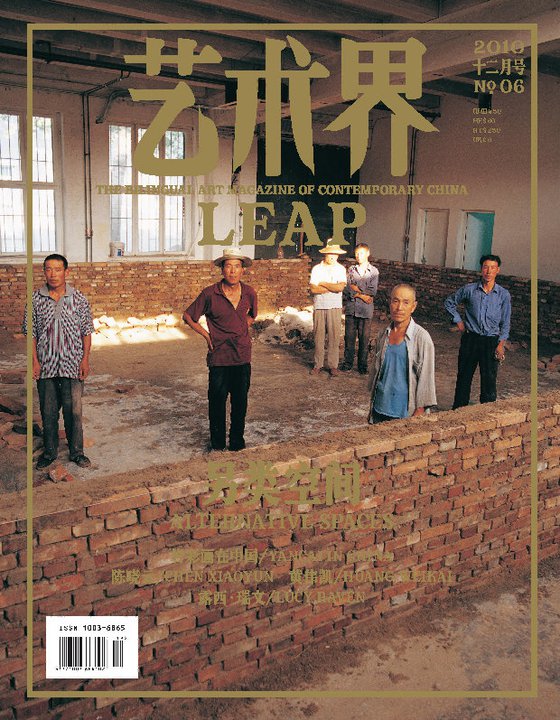
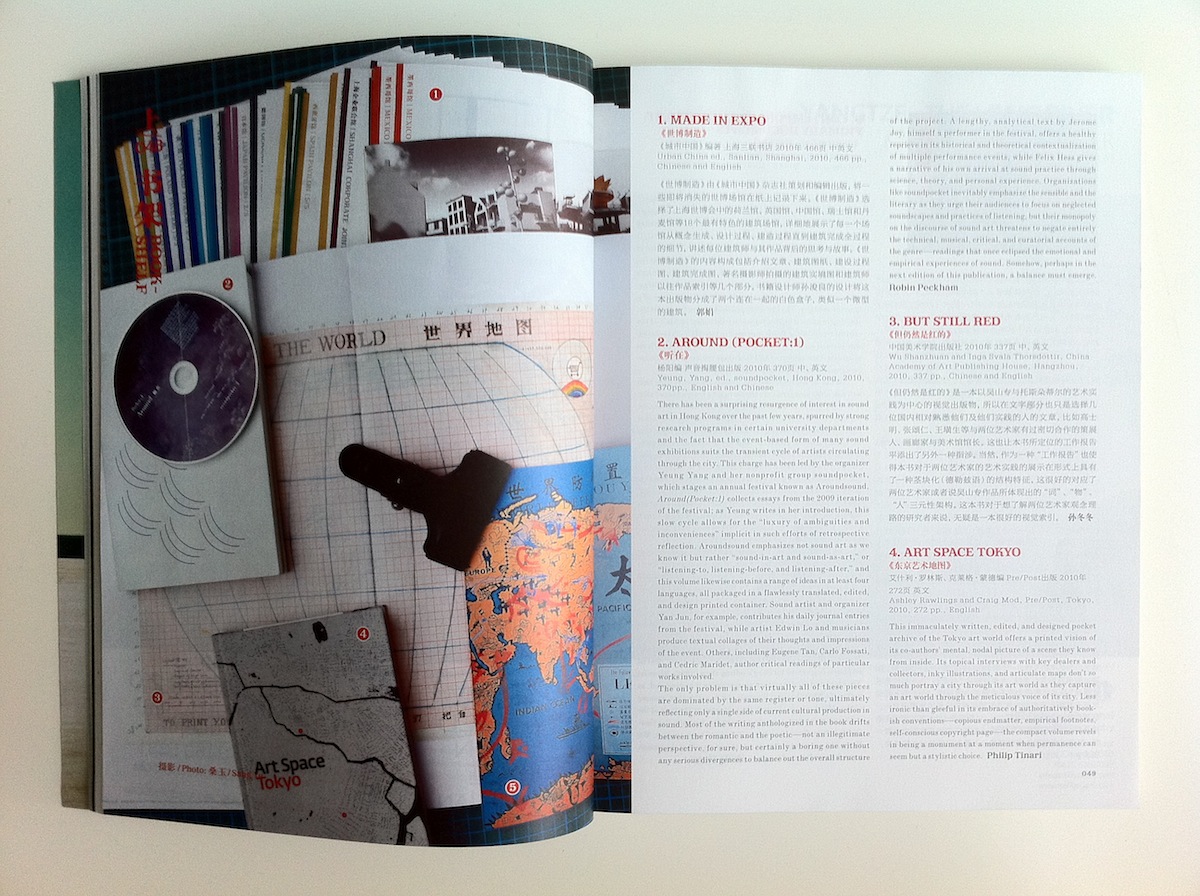
The year has already got off to a good start for us. We just received a copy of the December issue of LEAP, a bilingual Chinese-English periodical on contemporary art in China. In it, its editorial director, Philip Tinari, wrote a brief but glowing review of AST—one that appreciates our enthusiasm for the Tokyo art world, the city and the art of bookmaking.
This immaculately written, edited, and designed pocket archive of the Tokyo art world offers a printed vision of its co-authors’ mental, nodal picture of a scene they know from the inside. Its topical interviews with key dealers and collectors, inky illustrations, and articulate maps don’t so much as portray a city through its art world as they capture an art world through the meticulous voice of its city. Less ironic than gleeful in its embrace of authoritatively bookish conventions—copious endmatter, empirical footnotes, self-conscious copyright page—the compact volume revels in being a monument at a moment when permanence can seem but a stylistic choice.
Thank you, Philip!
Craig Mod and Art Space Tokyo in the Japan Times
 The Japan Times recently ran an article on none other than Art Space Tokyo’s designer and publisher Craig Mod.
Craig’s essays, “Books in the Age of the iPad” and “Embracing the Digital Book” have won him attention from people across the publishing and IT industries, including the New York Times tech blog.
For Craig, Art Space Tokyo, and in particular the Kickstarter-funded reprint, are important milestones in developing his ideas about how we can maximize the potential inherent in digital publishing.
The second edition of Art Space Tokyo is now printed and copies will be shipped out to our loyal customers shortly.
Next week, I will be meeting with Craig in Tokyo to hold some AST events, discuss the AST iPad version and think about where we will take this project next. More on this soon!
The Tokyo Art Scene in ArtReview
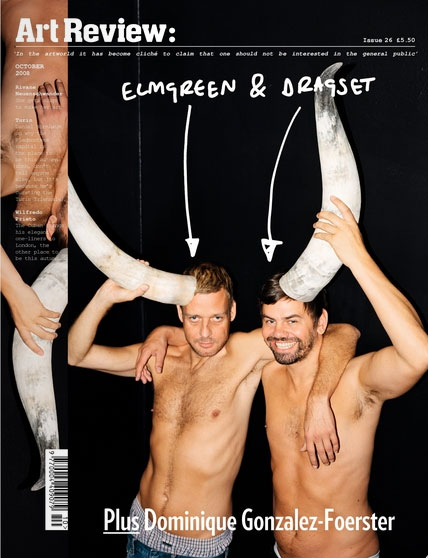 A feature article I wrote on the Tokyo art scene has been published in the October issue of ArtReview.
In it I talk about the next generation of artists who are defining Japanese art, such as Lieko Shiga, Miwa Yanagi, Kohei Nawa and Izumi Kato, as well as cross-genre exhibitions like last year’s “Space For Your Future”. I also explain how gallery owners like Taka Ishii and Tomio Koyama have cultivated a new generation of dealers out of the former staff of their galleries, such as Jeffrey and Misako Rosen, who set up their own gallery Misako & Rosen in 2006, which is reflective of a broader trend over the past four years.
ArtReview asked the Tokyo-based Swedish photographer Anders Edström to shoot some of the galleries, artists and dealers mentioned in my article, and I was pleasantly surprised by the images when I opened the magazine for the first time. Edström has captured some delightful, informal moments: among them, Jeffrey and Misako Rosen at their gallery between exhibitions, getting paintings ready to hang on the wall, and artist Tomoo Gokita in his studio and out in the street with his mother in the Koenji neighbourhood.
You can read this issue of ArtReview, as well as all of its past issues, by registering for free on its website.
Art Space Tokyo in Art & Antiques Magazine
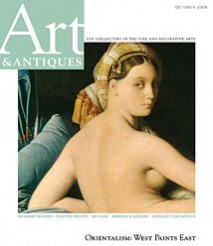 The October issue of Art & Antiques, a California-based magazine aimed at collectors of all kinds of art, including contemporary art, has a feature on the Tokyo art scene written by Edward M. Gomez.
Covering all kinds of art spaces that art enthusiasts should seek out on a visit to Tokyo, the article also mentions several that are featured in Art Space Tokyo, which Gomez calls “the best insider’s guide in English to the most interesting outposts for cutting-edge art in the Japanese capital”.
Quotes from AST crop up a couple of times in the article, including Tetsuya Ozaki’s views on the instability of the Chinese art market and Masami Shiraishi’s thoughts on how the Tokyo art scene is at its most vibrant in fifteen to twenty years.
Read the article online here.
Thank you Edward!
Japanese Contemporary Art in DAMN˚ Magazine
 The next issue of the very slick DAMn˚ magazine (#18), a Belgium-based publication that focuses on contemporary design, art and architecture, will feature a six page article on Japanese contemporary art that I wrote.
The article is essentially an introduction to the Tokyo contemporary art scene, aimed at those who are still under the impression that it’s all about Takashi Murakami and Yoshitomo Nara. I bring up a couple of other major figures like Naoya Hatakeyama and Tatsuo Miyajima, but more importantly some of the key names from the younger generation of contemporary artists, such as Tomoo Gokita, Izumi Kato and Tabaimo.
The article gives a brief overview of some of the galleries that established themselves in the post-bubble economic slump of the 1990s and how the Tokyo gallery world has developed since the early 2000s, in the shadow of the almost exclusive attention that has been paid to the rise of the Chinese contemporary art scene.
Interview in Ping Mag

A little while back, not long after Art Space Tokyo came out, Verena, the editor of Ping Mag interviewed us about a whole range of issues: from what led us to make the book, to how we made it, what we think of the state of art criticism in Tokyo and the current boom in museum building. We’re very pleased to have such an extensive, bilingual interview on a site with such a large, worldwide readership. You can read the interview in English here, or the Japanese translation of it here.
Art Space Tokyo in the Yomiuri Shinbun
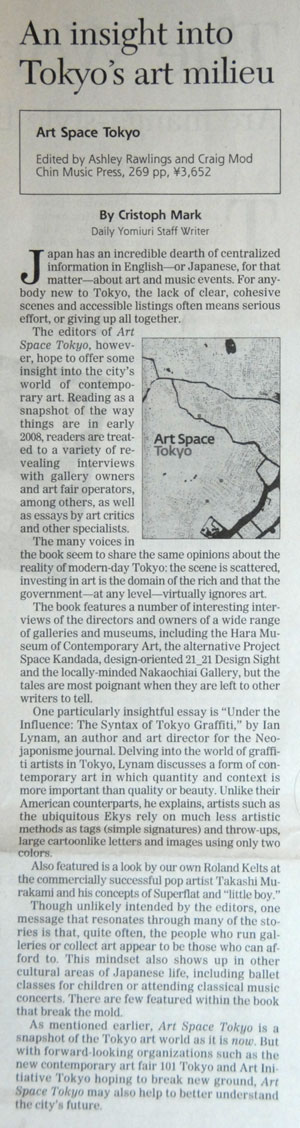 A review of Art Space Tokyo was published in the Yomiuri Shinbun today. If the print in the image to the left is too small for you to see, you can read the online version here.
It’s a true pleasure to see the book get a positive reception. However, Christoph Mark’s focus on the idea that “investing in art is the domain of the rich” is potentially misleading. Later in the article he says:
“Though unlikely intended by the editors, one message that resonates through many of the stories is that, quite often, the people who run galleries or collect art appear to be those who can afford to.”
Running a gallery is no different to running any other business: you need money and a shrewd mind to do it. And people who buy art are by definition “those who can afford to”, just as food, paperclips, helicopters and Louis Vuitton handbags are bought only by “those who can afford to.”
Certainly, there are people in Tokyo who cannot afford to spend money on art, but the barrier to worthwhile art investment in Tokyo is currently set considerably lower than it is in London and New York. Prices for small works by young artists start as low as ¥20,000 - 30,000 ($200 - 300), and even the big name artists sell for very reasonable prices compared to their peers in Europe, the US and China.
As Mark notes, Art Space Tokyo is meant as “a snapshot of the Tokyo art world as it is now… and may help to better understand the city’s future.” In editing the book, I purposefully did not want to overstate the message that contemporary art in Tokyo is cheap. But it is. In my opinion, the Japanese contemporary art market is a collector’s paradise, full of insanely good bargains.
But it won’t stay this way for ever. When I asked collector Ryutaro Takahashi for his thoughts on future trends in Japanese contemporary art, he replied:
“Speaking in terms of quality versus cost, some Asian collectors have said that works by Japanese artists fetch a mere twenty-five percent of their true value, while Korean artists get fifty percent and Chinese artists are getting one hundred percent.... The talk is that in five or so years, the price-to-quality ratio for artwork in these three countries will equalize. At the very least, we can expect the work of young Japanese artists to grow in value for the next five years.” (p.49)
Art Space Tokyo in the Guardian
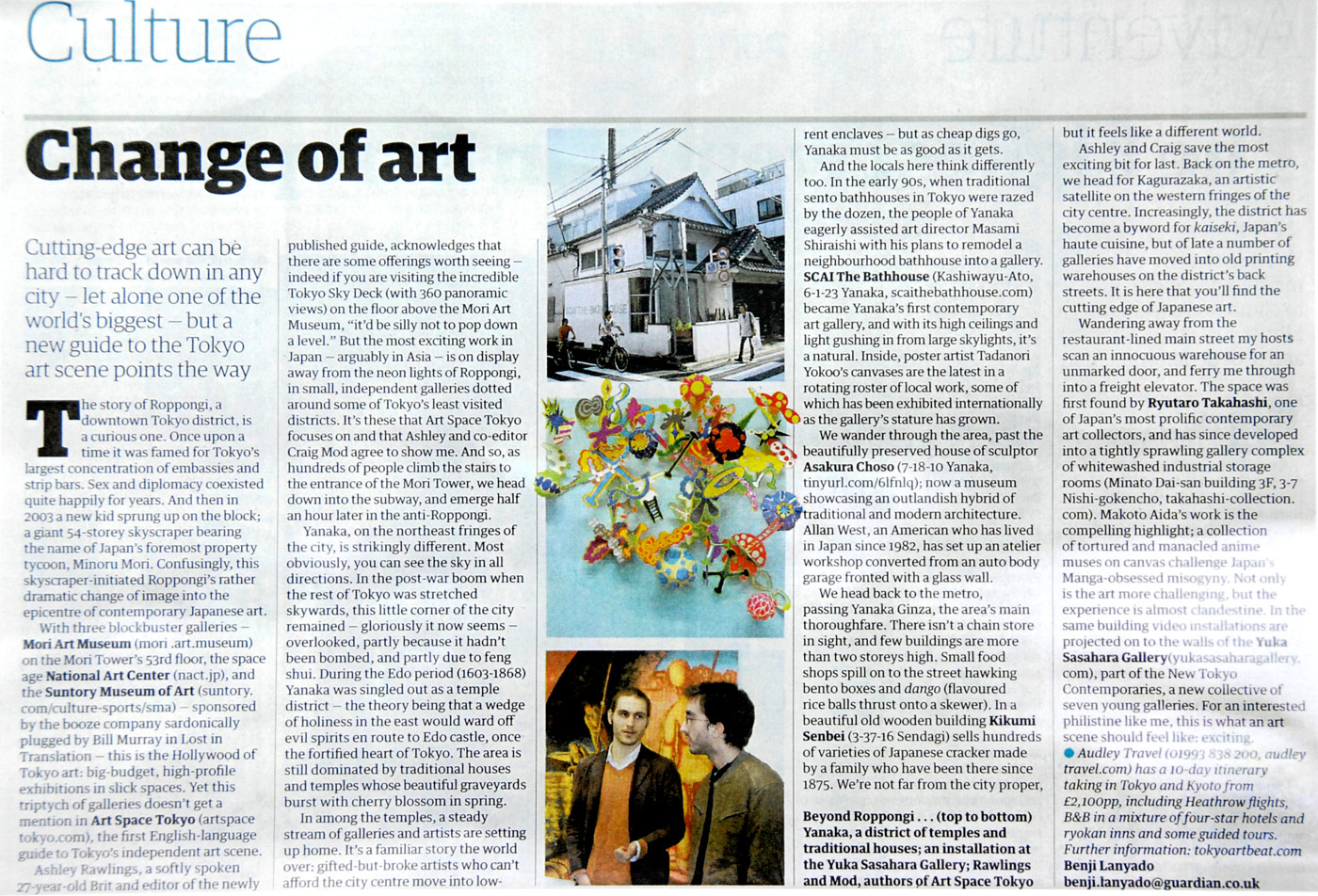
Back in March, Craig and I showed a reporter from the Guardian around some of Tokyo’s museums and galleries, including a couple of the spaces featured in Art Space Tokyo. The article came out today but you can read it on the Guardian website here, or for a look at the printed version, click on the image above.
About & Community
A place to keep abreast of Art Space Tokyo related news, reviews, events and updates.
Art Space Tokyo is a 272 page guide to the Tokyo art world produced and published by Craig Mod & PRE/POST.
It was originally published in 2008 by Chin Music Press.
Current Tokyo exhibitions
Powered by Tokyo Art Beat